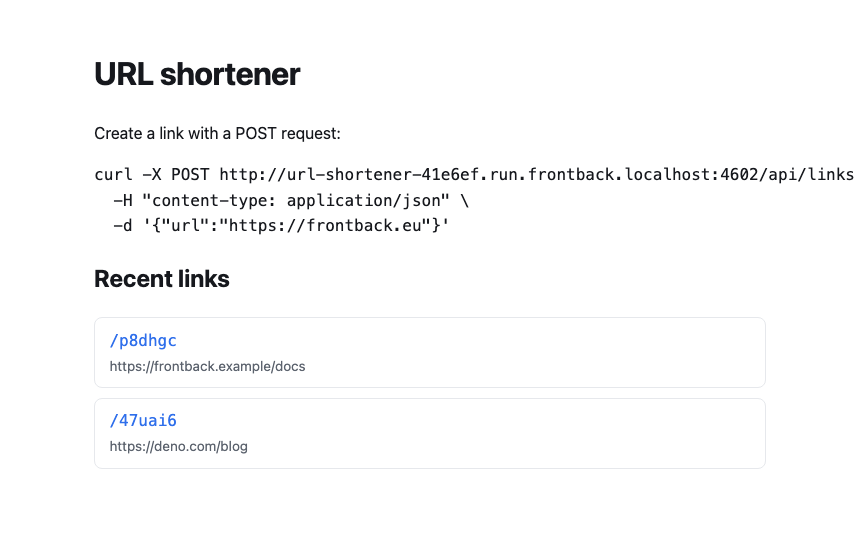
POST a long URL, get a short code, and 302-redirect from it.
libsqlredirectsstorage
POST a URL to /api/links and get back a short code; visiting /<code> answers with a 302 redirect to the original link. The links live in a libsql database provisioned and linked at deploy time as LINKS_DB, so the connection string carries no token and no secret ever appears in the code.
Codes are short and random. If one is already taken the insert fails on the primary key and the service simply tries another, so collisions are handled without a unique-id service. Only http and https URLs are accepted; anything else is rejected with a 422, so the shortener can never redirect a visitor to a javascript: or file: URL.
// A URL shortener. POST a long URL to /api/links and get back a short code;// visiting /<code> redirects there with a 302. Links live in a libsql database// that was created and linked for you at deploy time: its connection string// arrives in LINKS_DB as a tokenless URL, with credentials injected by the// platform at the network edge, so no secret ever appears in this code.import{ createClient }from"npm:@libsql/client@0.14.0/web";const db =createClient({ url:Deno.env.get("LINKS_DB")!});typeLink={ code: string; url: string; created_at: string };constALPHABET="abcdefghijklmnopqrstuvwxyz0123456789";exportdefaultasync(req:Request):Promise<Response>=>{await db.execute(`CREATE TABLE IF NOT EXISTS links (
code TEXT PRIMARY KEY,
url TEXT NOT NULL,
created_at TEXT NOT NULL DEFAULT (datetime('now'))
)`,);const url =newURL(req.url);const{ pathname }= url;// Create a short link. Body: { "url": "https://..." }if(req.method ==="POST"&& pathname ==="/api/links"){const body =await req.json().catch(()=>null);const target =typeof body?.url ==="string"? body.url.trim():"";// Only http(s) links are allowed. Reject anything else with a 422 so we// never store a "javascript:" or "file:" URL and redirect a visitor to it.if(!isHttpUrl(target)){returnjson({ error:"Provide an http or https URL."},422);}const code =awaitcreateUniqueLink(target);returnjson({ code, url: target, short:`${url.origin}/${code}`},201);}// Follow a short link: GET /<code> -> 302 redirect to the stored URL.const code = pathname.slice(1);if(req.method ==="GET"&&/^[a-z0-9]+$/.test(code)){const found =await db.execute({
sql:"SELECT url FROM links WHERE code = ?",
args:[code],});if(found.rows.length ===0){returnjson({ error:"Unknown code."},404);}returnnewResponse(null,{
status:302,
headers:{ location:String(found.rows[0].url)},});}// Index: a form plus the most recent links.if(req.method ==="GET"&& pathname ==="/"){returnrender(awaitrecentLinks(), url.origin);}returnjson({ error:"Not found."},404);};// Insert with a fresh random code, retrying if that code is already taken.// The PRIMARY KEY makes a duplicate insert fail, which we catch and retry.asyncfunctioncreateUniqueLink(target: string):Promise<string>{for(let attempt =0; attempt <5; attempt++){const code =randomCode();try{await db.execute({
sql:"INSERT INTO links (code, url) VALUES (?, ?)",
args:[code, target],});return code;}catch(error){if(String(error).includes("UNIQUE"))continue;// collision: try againthrow error;}}thrownewError("could not allocate a unique code");}functionrandomCode(length =6): string {const bytes = crypto.getRandomValues(newUint8Array(length));let code ="";for(const byte of bytes) code +=ALPHABET[byte %ALPHABET.length];return code;}functionisHttpUrl(value: string): boolean {try{const parsed =newURL(value);return parsed.protocol ==="http:"|| parsed.protocol ==="https:";}catch{returnfalse;}}asyncfunctionrecentLinks():Promise<Link[]>{const result =await db.execute("SELECT code, url, created_at FROM links ORDER BY created_at DESC LIMIT 50",);return result.rows.map((row)=>({
code:String(row.code),
url:String(row.url),
created_at:String(row.created_at),}));}functionrender(links:Link[], origin: string):Response{const rows = links.length ===0?`<p class="empty">No links yet.</p>`: links
.map((link)=>`<li>
<a href="/${link.code}">/${link.code}</a>
<span>${escapeHtml(link.url)}</span>
</li>`,).join("\n ");const body =`<!doctype html>
<html lang="en">
<head>
<meta charset="utf-8" />
<meta name="viewport" content="width=device-width, initial-scale=1" />
<title>URL shortener</title>
<style>
body { max-width: 42rem; margin: 3rem auto; padding: 0 1.25rem;
font: 16px/1.6 system-ui, sans-serif; color: #16181d; }
h1 { letter-spacing: -0.02em; }
code { font-family: ui-monospace, monospace; }
ul { list-style: none; padding: 0; display: grid; gap: 0.6rem; }
li { display: grid; gap: 0.15rem; border: 1px solid #e6e8ec;
border-radius: 8px; padding: 0.6rem 0.9rem; }
li a { font-family: ui-monospace, monospace; color: #2f6feb;
text-decoration: none; }
li span { color: #5c636e; font-size: 0.85rem; word-break: break-all; }
.empty { color: #5c636e; }
</style>
</head>
<body>
<h1>URL shortener</h1>
<p>Create a link with a POST request:</p>
<pre><code>curl -X POST ${origin}/api/links \\
-H "content-type: application/json" \\
-d '{"url":"https://frontback.eu"}'</code></pre>
<h2>Recent links</h2>
<ul>
${rows}
</ul>
</body>
</html>
`;returnnewResponse(body,{
headers:{"content-type":"text/html; charset=utf-8"},});}functionjson(data: unknown, status =200):Response{returnnewResponse(JSON.stringify(data),{
status,
headers:{"content-type":"application/json; charset=utf-8"},});}functionescapeHtml(value: string): string {return value
.replace(/&/g,"&").replace(/</g,"<").replace(/>/g,">").replace(/"/g, """).replace(/'/g, "'");}